

The Seven Deadly Sins and Their Real Meaning


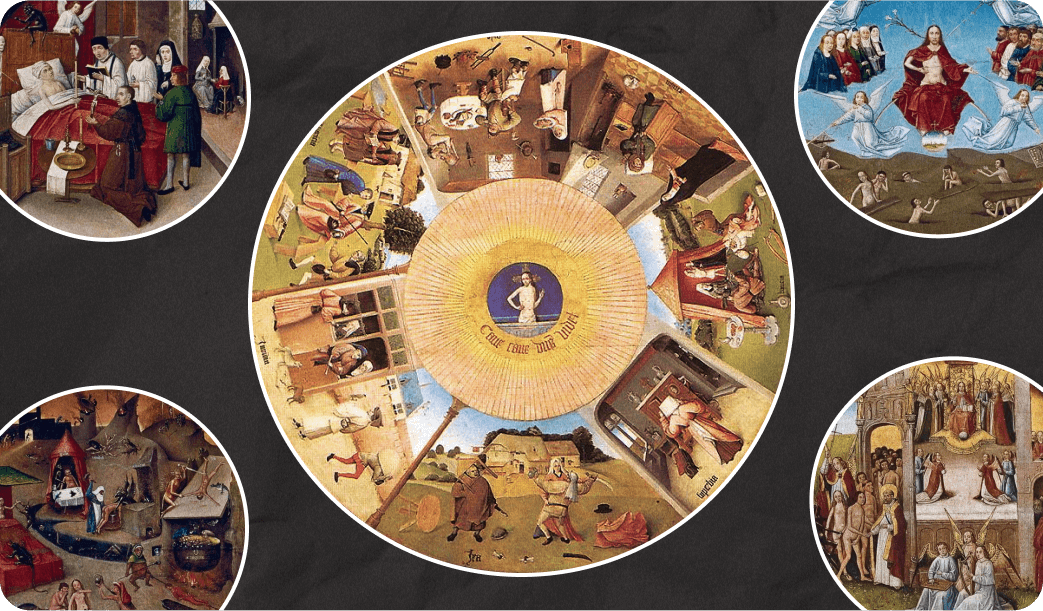
Many people know about the Seven Deadly Sins through art: Dante described them in detail in The Divine Comedy, while Hieronymus Bosch and Pieter Bruegel depicted them in paintings and engravings. But did you know that neither a list of these sins nor their classification as “deadly” appears in the Bible? So where did they come from? Let’s find out.
The Deadly Sins in the Bible
There are only references to the deadly sins in the Bible. There are only hints of the deadly sins in the Bible.
In the Book of Proverbs, seven “abominations” are listed: “haughty eyes, a lying tongue, hands that shed innocent blood, a heart that devises wicked plans, feet that run swiftly to evil, a false witness who pours out lies, and one who sows discord among brothers” (Proverbs 6:16–19).
In his Letter to the Galatians, the Apostle Paul lists many more sins:
“The works of the flesh are evident: adultery, fornication, impurity, debauchery, idolatry, sorcery, hatred, strife, jealousy, wrath, selfish ambitions, dissensions, factions, envy, murders, drunkenness, revelries, and the like. I warn you, as I warned you before, that those who practice such things will not inherit the kingdom of God” (Galatians 5:19–21).
Notice that the expression “works of the flesh” emphasizes the importance of spiritual growth, since it is this growth that leads a person to the Kingdom of God. Yet even here, we still do not find a clear concept of the Seven Deadly Sins.
Thus, the transgressions described in the Bible differ from the list we are familiar with today. You will not find lust, pride, or even gluttony explicitly listed here. However, the Scriptures already contain the idea that certain sins are especially grave, so it is only natural that later Christian thinkers developed this concept further.
Who Came Up with the Seven Deadly Sins?

The concept of the deadly sins was first described by Evagrius Ponticus, a Christian thinker of the 4th century. In his work On the Eight Evil Thoughts (addressed to Anatolius), he identified eight passions that hinder a person’s spiritual growth: gluttony, lust, greed, sorrow, anger, acedia (spiritual despondency), vainglory, and pride.
Evagrius believed that these deadly passions are natural to human beings and do not arise from personal choice, but that they must be resisted in order to prevent moral and spiritual decline.
He argued that gluttony distracts monks from strict moderation in food and leads to idle fantasies. These fantasies, in turn, prevent them from practicing ascetic discipline—the spiritual exercises aimed at purification of the soul. Lust, as you might expect, also interferes with monastic life because it leads to the abandonment of the required vow of chastity.
Greed, according to Evagrius, exposes monks to hunger, illness, and other hardships. Sorrow often accompanies thoughts of one’s life before entering monasticism, making it another undesirable passion. Anger “hardens the soul,” while acedia prevents a person from engaging in meaningful and beneficial activities. Vainglory, in Evagrius’s view, gives rise to the other sins, while pride ultimately leads a person to reject God.
As you can see, all eight evil thoughts identified by the philosopher were closely tied to monastic life. Although he was not writing for all Christians, his concept of the eight sins became influential within Christian tradition and was later developed by other thinkers. In the 6th century, Pope Gregory I revised Evagrius’s list.He combined sorrow with acedia (spiritual despondency) and vainglory with pride, and he also added envy to the list. This formed the canon in which the number of deadly sins became seven.
The Christian theologian Thomas Aquinas supported Gregory I’s concept and described these sins in his work Summa Theologica as the principal sins—that is, the sins that give rise to all others.
Thus, the Seven Deadly Sins did not appear in Christianity all at once. They underwent several transformations before becoming the widely recognized concept known today.

The Deadly Sins in Catholicism

The Catechism of the Catholic Church lists two types of sins: venial and mortal.
God forgives those who commit venial sins, because such sins do not lead to a complete loss of His love. They merely “offend and wound” that love, and if the sinner sincerely repents, it can be restored.
Mortal sins, however, are more serious. The Catechism of the Catholic Church states:
“Mortal sin is sin whose object is grave matter and which is also committed with full knowledge and deliberate consent.”
“Grave matter” refers to violations of the commandments given in the Gospel of Mark: “Do not commit adultery, do not kill, do not steal, do not bear false witness, do not defraud, honor your father and your mother.”
A mortal sin is therefore a conscious and freely chosen act. A person must understand that a sin becomes “mortal” when it deliberately contradicts God’s law.
As you can see, these are not the same sins identified by Gregory I. In fact, the Catechism contains no fixed list of sinful acts at all. It is intended to be universal for Catholics around the world, so “mortal sins” cannot be limited to the seven described by Gregory I.
Nevertheless, it is Gregory’s list—not the Catechism’s abstract definition—that became deeply embedded in culture. Consider, for example, The Divine Comedy by Dante Alighieri. Its second part, Purgatorio (Purgatory), is devoted to the seven vices. In Catholic basilicas as well, such as Basilica of Notre-Dame de Fourvière, one can find mosaics depicting the deadly sins.
The seven sins, in their traditional order, are:
Pride, Greed, Wrath, Envy, Lust, Gluttony, and Sloth.
What does Orthodoxy say about deadly sins?
In Eastern Orthodoxy, deadly sins are understood as grave, unforgiven transgressions that separate a person from God.
The Orthodox Church, like the Catholic Church, emphasizes the conscious nature of such sins. Ignatius Brianchaninov wrote:
“If someone dies in a mortal sin without having repented of it, his soul goes to hell. There is no hope of salvation for it.”
Thus, any sin that has been atoned for and forgiven ceases to be mortal.
The Catechism of the Orthodox Catholic Eastern Church identifies as the gravest sins those that violate the Ten Commandments, which were first set forth in the Old Testament. This means that, here too, there is no official adoption of the concept of the Seven Deadly Sins.
However, just as in Catholicism, Orthodoxy has a teaching about human vices. In the Orthodox tradition, these are often counted not as seven, but as eight, reflecting the earlier classification associated with Evagrius Ponticus.

In Orthodoxy, Evagrius’s “eightfold” classification of sins is also well known. Nil Sorsky wrote that fasting is essential to avoid gluttony and that one should drive away thoughts that lead to lust.
In his view, greed creates attachment to worldly concerns and weakens spiritual ones. Anger causes a person to turn away from mercy and from God. Sorrow leads to despair, while acedia (spiritual despondency) results in ingratitude and blasphemy. Vainglory encourages the pursuit of human approval instead of service to God, and pride prevents humility before Him.
Later, in the 19th century, Ignatius Brianchaninov described each of these sins in greater detail and broadened their meaning. For example, he understood gluttony not only as overeating but also as drunkenness, and lust not only as immoral sexual acts but even as obscene or foul language. Notice that in Orthodoxy there is no, and never has been, a distinction between “monastic” and “worldly” sins, as there was in Catholicism. In this tradition, the “eight passions” apply equally to everyone. This idea stems from the Orthodox understanding of human nature and spiritual struggle. All people, regardless of their social position or religious status, are called to strive for the salvation of their souls and the attainment of holiness.
As a result, the concept of the eight vices in the Eastern Church is more universal. Orthodox Christians believe that every sin can lead to greater sins, making it unnecessary to single out a separate list of especially deadly transgressions.
As you can see, the concept of deadly sins is an important part of Christian teaching. Although neither the Bible nor official church documents establish a definitive list, the idea of the Seven Deadly Sins has become widespread in both religious and secular culture.
Artists and sculptors have portrayed them as personified figures, Kurt Weill composed music for a ballet of the same name, and the sins themselves have even appeared as characters in anime.

And now you know how this concept evolved:
- The Deadly Sins are not explicitly described in the Bible. The eight vices were first described by the Christian philosopher Evagrius Ponticus. Originally, this list was intended for monks, but later Gregory I and, after him, Thomas Aquinas developed a version for the laity. In that version, only seven sins remained.
- In both Catholicism and Orthodoxy, the sins are counterbalanced by an equal number of virtues: Catholicism recognizes seven virtues, while Orthodoxy recognizes eight. In both traditions, these virtues help believers resist and overcome the deadly sins.
- Analogues of the deadly sins exist in other religions as well. In Islam, they are known as al-kabā’ir—the major sins—while in Buddhism, there are the Three Poisons and the Five Hindrances, which obstruct spiritual development and enlightenment.
There is nothing surprising about this, since all religions are concerned with spiritual self-improvement and therefore need to identify the obstacles that stand in the way of that spiritual journey.